Math weekly homework for the full year, one page per week
There are two kinds of homework systems. The first is invented every Thursday night at the copier, and it shows: some weeks are three stapled pages, some weeks are nothing, and by February families have stopped looking in the folder. The second is set up once in August and then simply runs. One page, every week, same format, all 36 weeks.
I built my homework line around the second kind, because the research on elementary homework and my own years of collecting it agree on one thing: consistency beats volume. Here is how a full-year weekly homework system works, and how to run it without adding a single Thursday night to your life.
Why one page per week beats a nightly packet
A weekly page split into Monday through Friday boxes does quietly clever things that a nightly worksheet cannot.
- Families can plan around it. Soccer on Tuesday? Do two boxes Wednesday. The week is the unit, so home schedules stop being homework emergencies.
- Nothing gets lost daily. One sheet goes home Monday and comes back Friday. Four fewer trips through the backpack means four fewer chances to vanish.
- You can see a whole week at a glance. A Friday flip through the pile shows you who practiced, who guessed, and which box everyone bombed.
- It builds the habit, not just the skill. A few problems a night, all year, is how math facts actually stick. The tracker page in each packet lets students check off each finished day themselves.
What a full year of spiral review looks like
Every weekly page in these packets mixes several skills, so the review really is spiral: multiplication from October still appears in April, place value never fully leaves the rotation. The year has a deliberate shape to it:
Quarter 1: warm up on last year
The first weeks review the prior grade. September homework should build confidence and routine, not tears at the kitchen table.
Quarters 2 and 3: the working middle
On-grade practice across the whole skill set. For 3rd grade that means multiplication, division, fractions, place value, rounding, skip counting, and geometry; for 5th, multiplication and division, fractions, place value, geometry, and multi-step word problems. Each grade's packet covers its full stack.
Quarter 4: finish on end-of-year material
The last weeks land on the hardest content of the year, timed for when the class is ready for it.
The full year, grade by grade
Each grade-level packet is 43 pages: 36 weekly pages, the student tracker, and complete answer keys for every week. They are $14.95 each, and the three packets in each bundle come to $44.85 bought separately, so the bundle carries all three grades for about half.
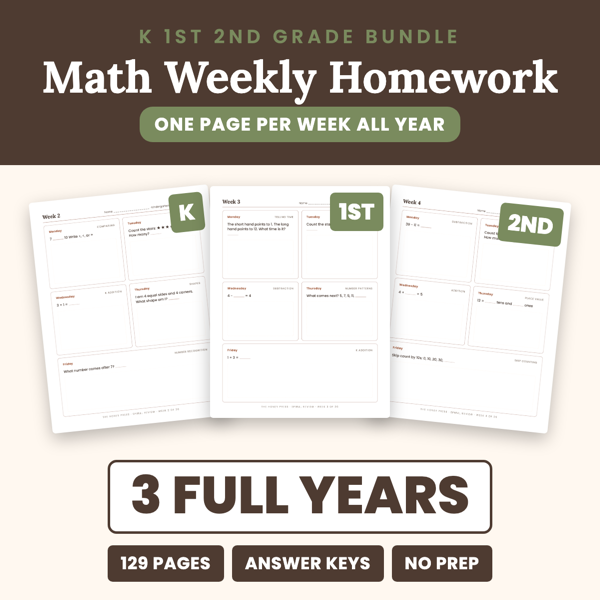 Kindergarten 1st 2nd Grade Math Weekly Homework BUNDLE Grades: K - 2nd A full year of weekly homework for K, 1st, and 2nd, ready on day one. 129 pages $22.95 Answer keys included See it on TPT →
 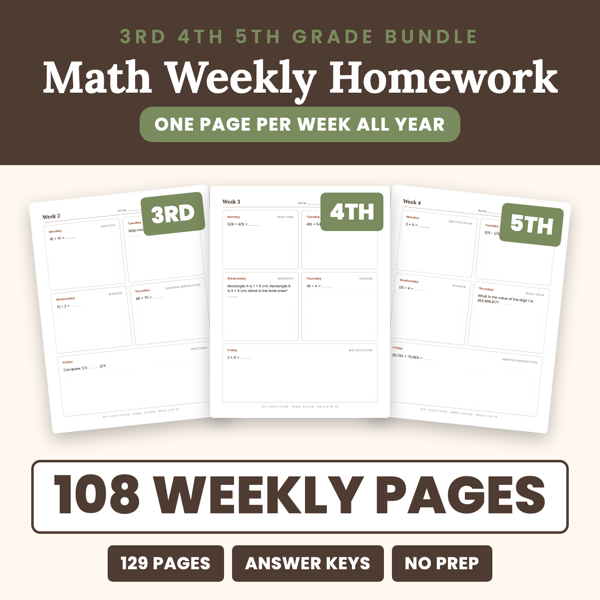 3rd 4th 5th Grade Math Weekly Homework BUNDLE Grades: 3rd - 5th Homework for the whole year across three grades: 108 weekly pages, one per week. 129 pages $22.95 Answer keys included See it on TPT →
 Prefer a single grade? Each one stands alone:
- Kindergarten Math Weekly Homework (K, $14.95, 43 pages)
- 1st Grade Math Weekly Homework (1st, $14.95, 43 pages)
- 2nd Grade Math Weekly Homework (2nd, $14.95, 43 pages)
- 3rd Grade Math Weekly Homework (3rd, $14.95, 43 pages)
- 4th Grade Math Weekly Homework (4th, $14.95, 43 pages)
- 5th Grade Math Weekly Homework (5th, $14.95, 43 pages)
See inside before you buy
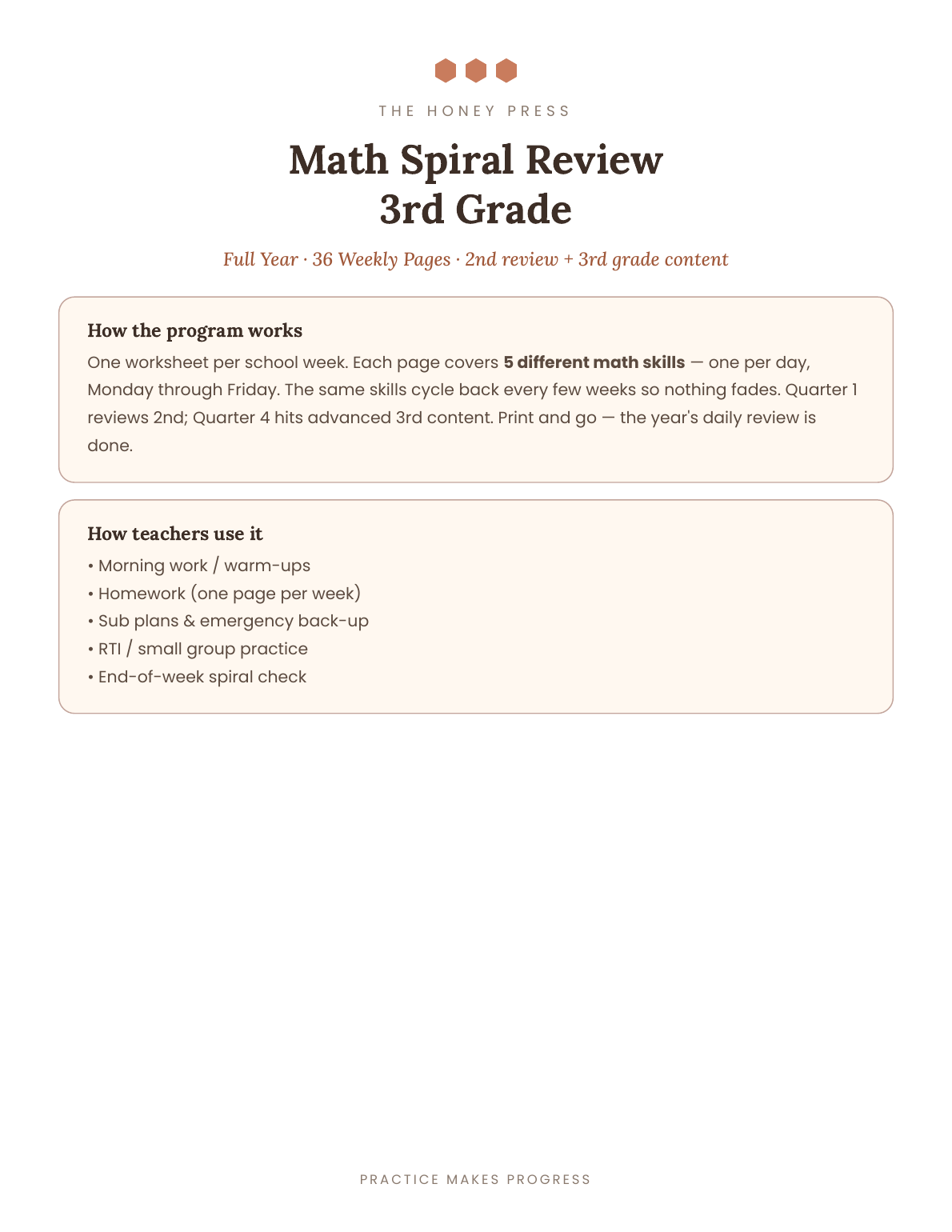
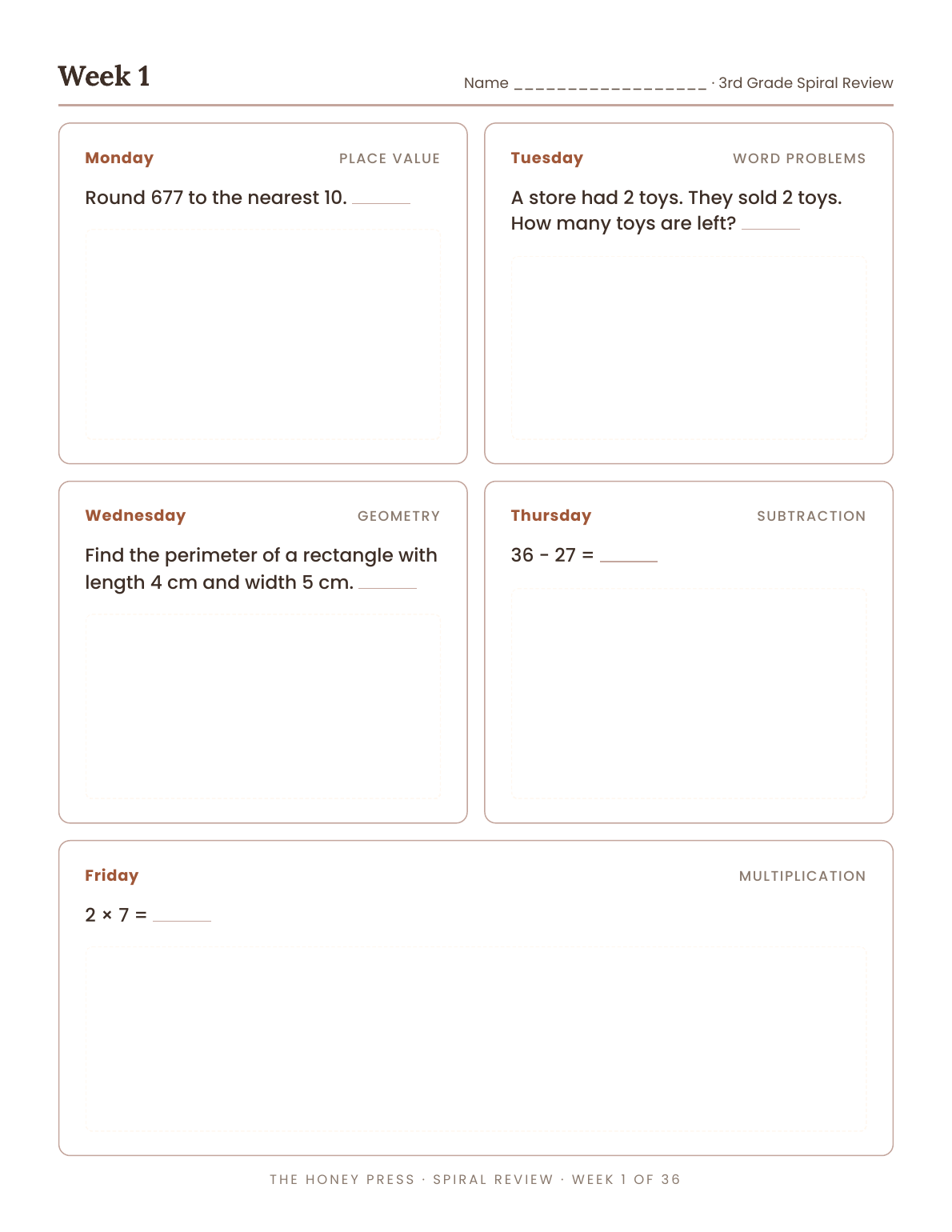
These are real pages from the 3rd grade packet, exactly as they print: the overview page and the Monday-to-Friday weekly pages. All six grades share the same format. Flip through:
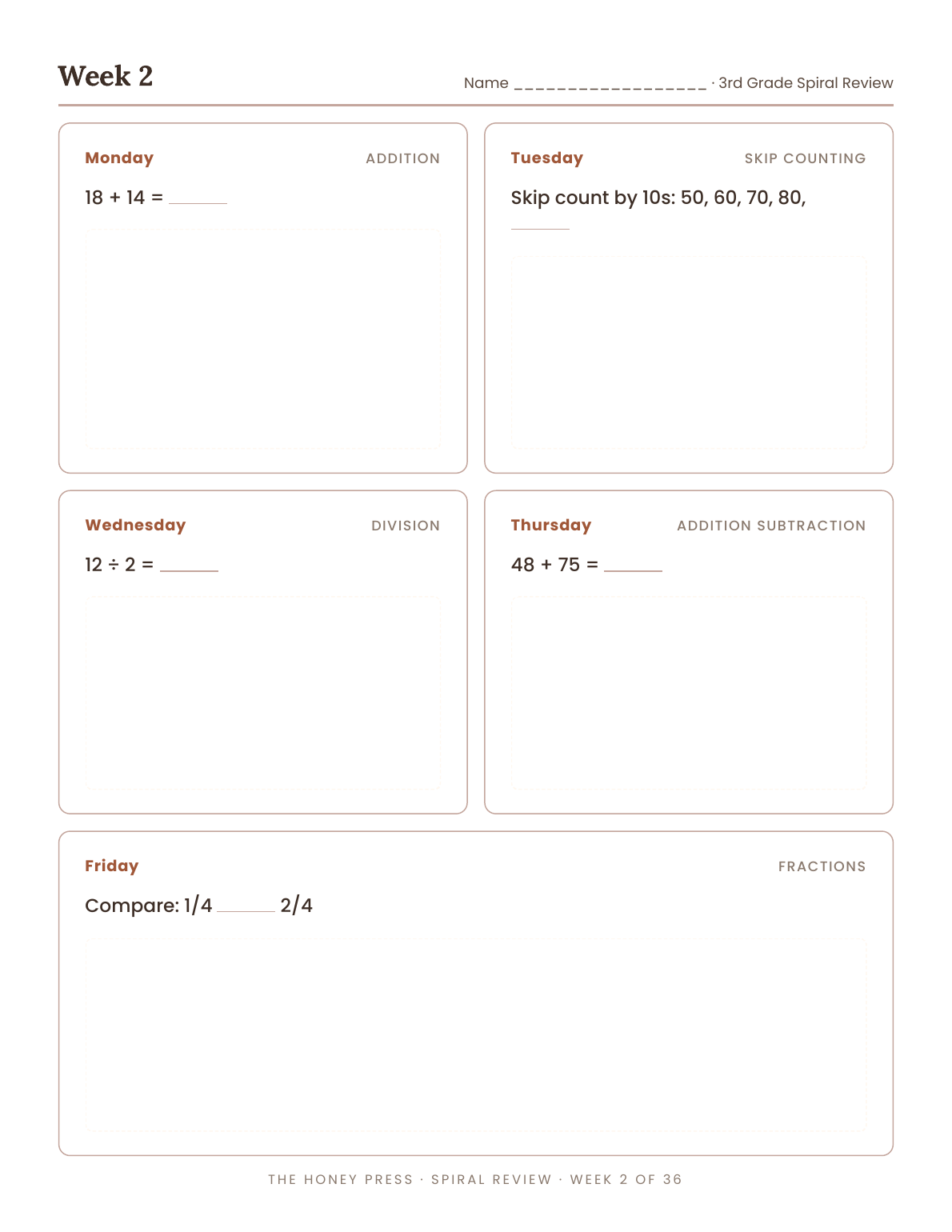
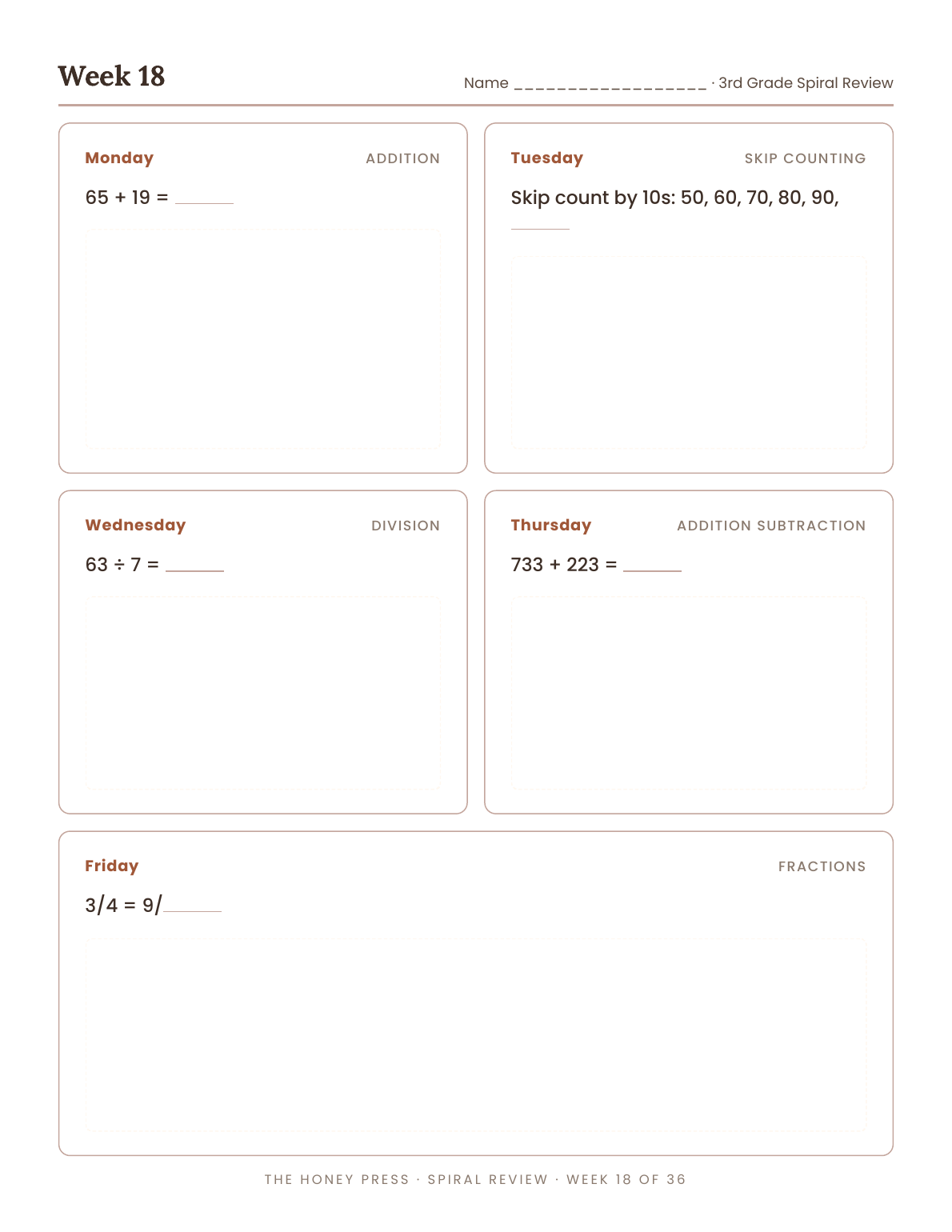
Tap or click the page to flip through. Arrow keys work too.
Setting up the whole year in one afternoon
This is the part I love most about the system: the entire year of homework is one session at the copier.
- Print the 36 weekly pages, one class set each, or a month at a time if paper is rationed.
- Drop each week into a hanging file labeled Week 1 through Week 36.
- Every Monday, the top file goes in the mailboxes. Every Friday, it comes back.
- Keep the answer keys in a binder by your desk for the Friday spot-check.
The pages are clean white backgrounds on purpose, easy on your toner and on the printers of families who print a lost page at home. And because the routine never changes, a substitute can run homework collection without a note, which is one more thing your sub folder does not have to explain.
The routine even survives winter break: the ten-day winter break packets carry the same one-sheet-a-day habit home over the holidays, so January does not start from zero.
Frequently asked questions
How much math homework is one week in this system?
One page. Each weekly page is split into Monday through Friday boxes, a few problems per day, mixing several skills. A student spends five to ten minutes a night, and the whole week travels home as a single sheet.
Does weekly homework spiral, or follow my unit order?
It spirals. Every page mixes several skills, so September learning is still being practiced in March. Quarter 1 warms up with review of the prior grade, and Quarter 4 finishes on end-of-year material, so the difficulty follows the shape of a school year rather than any one curriculum.
How do I grade 36 weeks of homework without drowning?
Complete answer keys are included for all 36 weeks, and the one-page format makes a spot-check realistic: collect on Friday, check two or three problems against the key, and mark the tracker. Many teachers grade for completion and use the Friday boxes as a quick pulse check.
What if I teach multiple grades or have kids at different levels?
The packets share one format across K through 5th grade, so the routine looks identical while the content changes. The three-grade bundles exist for exactly this: siblings at home see the same homework shape, and you can hand a struggling student a page from one grade down without it looking different.