Main idea and supporting details: twenty days of nonfiction passages
A short nonfiction passage to read, then 5 questions and an organizer to answer, in 10 to 15 minutes a day. Four weeks, one step a week, with a Check Day to close every week. One packet per grade, 3rd through 5th grade, or all three in one bundle.
Passages by grade
Bundle: best value
How the twenty days run
Ask a third grader for the main idea and you often get one detail back, or just the topic. Most fourth graders can tell you what a text is about; saying what it is mostly about, in one clear sentence, and pointing to the details that prove it is the harder job. Fifth grade raises the bar again, to texts with two or more main ideas. These packets practice that job one step a week, and every answer can be checked against the words in the passage.
One day, two pages
- A Learn It page opens each week. You read it together: a named strategy, the key words, a model text and a teacher think-aloud that shows where the proof is.
- The Read page holds a short nonfiction passage and one While I Read task, such as underlining the sentence that states the main idea or starring each key detail.
- The Respond page has 5 multiple-choice questions and an organizer.
- Day 5 of every week is a Check Day: 5 questions and a short written response in place of the organizer, done without help.
- For you: teacher pages with the skill progression and the two standards, and a class record for daily scores and writing scores.
- For students: an anchor page that sets topic, main idea and supporting details side by side, and a progress tracker where they log each score and rate each week's goal.
- Answer keys with the letter, the answer, the paragraph and the exact words that prove it, plus sample answers and a 0 to 2 guide for the writing.
How the help steps back
Day 1 of each week shows one organizer box filled in as a model. On Days 2 to 4 every box is blank, and the Check Day has no organizer at all. Topic questions come back in later weeks, and every week asks what single paragraphs are mostly about. The passages get longer as the weeks go on:
- 3rd grade: about 150 to 166 words in Week 1, 202 to 210 words in Week 4.
- 4th grade: about 172 to 177 words in Week 1, about 243 to 272 words by Week 4.
- 5th grade: about 207 to 226 words in Week 1, about 253 to 278 words in Week 4.
What each grade covers
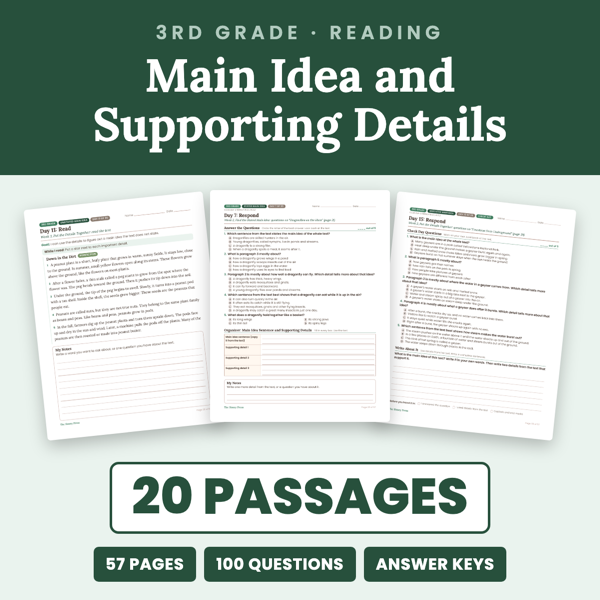
- 3rd grade (57 pages, $7.95): Four weeks, one step a week: name the topic, find a main idea the text states, work out one it does not state, then sum up a text with its main idea and key details.
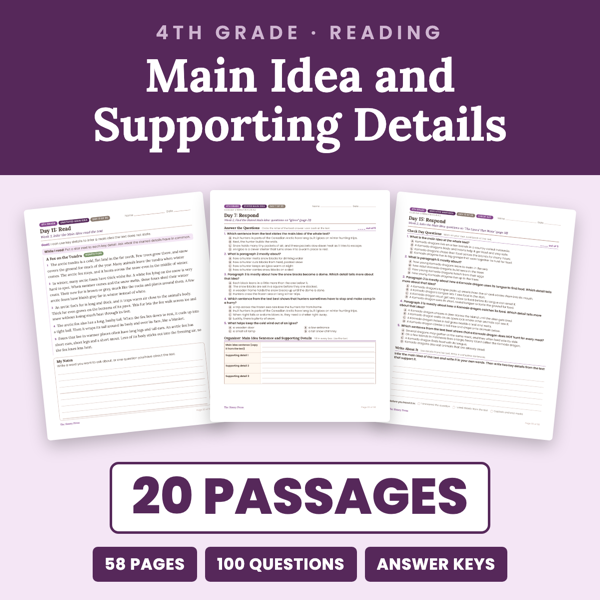
- 4th grade (58 pages, $7.95): Four weeks, one step a week: pair the topic with a main idea, find the sentence that states it, infer it when no sentence does, and retell a whole text in a short summary.
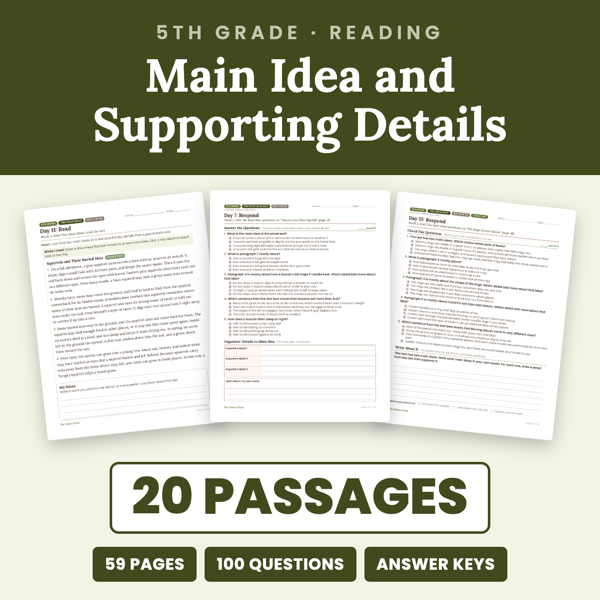
- 5th grade (59 pages, $7.95): Four weeks, one step a week: a main idea the text states, one it only implies, two main ideas in a single text, and a summary of a text that has two.
Each packet holds 20 nonfiction passages, 4 Learn It lessons with model texts, 100 multiple-choice questions, 16 organizers and 4 written responses. Every text is original nonfiction written for its packet.
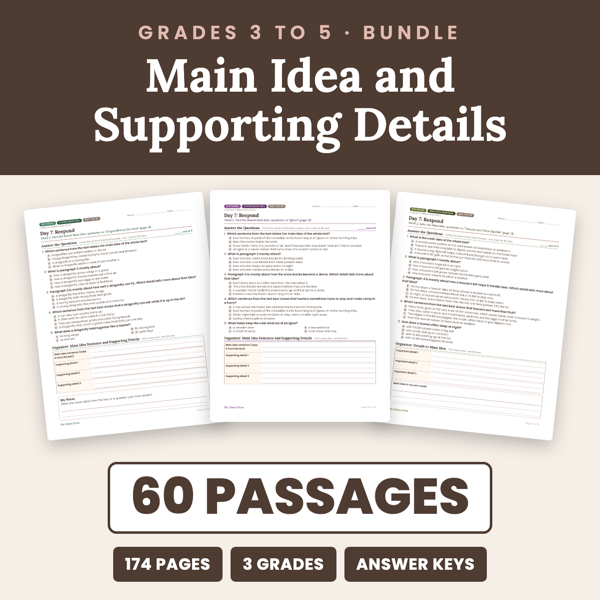
The 3rd through 5th grade bundle carries all three grades, 174 pages, for $16.95, against $23.85 bought separately: 60 nonfiction passages, 12 Learn It lessons, 300 multiple-choice questions, 48 organizers and 12 written responses. It suits a teacher with more than one grade, or a school building one plan across 3rd to 5th.
Where it fits
Whole-class practice, small groups, centers, homework or morning work: the day is short and the same every time, so it runs anywhere you have ten to fifteen minutes.
For a small group that needs six weeks across several comprehension skills, the Tier 2 reading intervention packets are the longer option. For a day you are out, the reading sub plans give a substitute a week of passages and questions.
Frequently asked questions
How long does a day take?
Ten to fifteen minutes. A day is two pages: a Read page with a short nonfiction passage and one While I Read task, then a Respond page with 5 multiple-choice questions and an organizer. Five days make a week, four weeks make a packet.
What happens on a Check Day?
Day 5 of every week is a Check Day: 5 multiple-choice questions and a short written response in place of the organizer, done without help. The answer keys have sample answers for the written responses and a 0 to 2 scoring guide for the writing.
What changes in 5th grade?
Fifth grade builds up to texts that have more than one main idea. Week 1 finds a main idea the text states and Week 2 one it only implies. In Week 3 students find two main ideas in a single text: they draw a line where the text moves to a new main idea and star a key detail on each side of the line. Week 4 summarizes a text that has two main ideas.
How do I check the answers?
For every multiple-choice question the answer key gives the letter, the answer, the paragraph number and the exact words in the passage that prove it. Organizers and written responses come with sample answers.
Which standards does it cover?
Two per grade: RI.3.1 and RI.3.2 in 3rd grade, RI.4.1 and RI.4.2 in 4th, RI.5.1 and RI.5.2 in 5th. The teacher pages show the skill progression with both standards and where each one is practiced.
Do the three grades work the same way?
Yes. Every grade has the same two-page day, a Learn It page to open each week, a Check Day to close it and answer keys built the same way. The four weekly steps and the passages change with the grade: 3rd grade starts by finding the topic, 4th by pairing the topic with a main idea, and 5th with a main idea the text states.