Compare and contrast with paired texts: twenty days of nonfiction
Short nonfiction, most days a Text A and a Text B on one topic, then 5 questions and a chart that sorts what each text says, in 10 to 15 minutes a day. Four weeks, one step a week, with a Check Day to close every week: a written response takes the place of the chart. One packet per grade, 4th and 5th grade, or both in one bundle.
Paired passages by grade
How the twenty days run
With two texts on the page, a student has to keep track of which one said what. Each fact on a Compare Chart gets a cite box: the text and the paragraph on paired days, the paragraph alone on 4th grade's one-text days in Week 1. The key gives the paragraph and the exact words for every multiple-choice answer, so a claim about Text A can be checked against Text A.
Four weeks, one step each
- Week 1: in 4th grade, Compare in One Text: one text compares two things, and students find the signal words and tell whether it is organized block or point-by-point. In 5th grade, Two Texts, Two Subjects: two related subjects in two texts, plus telling an exact quotation from a near copy.
- Week 2, Two Texts, One Topic: What Each Adds: what both texts say, what only one of them says, and how their focus differs.
- Week 3: in 4th grade, Two Texts, Two Subjects: two related subjects compared across two texts. In 5th grade, Compare Text Structures: how each of two texts on one topic is organized, the signal words that show it, and how the two structures differ.
- Week 4, Put Two Texts Together: combine information from both texts to explain the topic. Day 20 is one paragraph written alone.
One day, two pages
- A Learn It page opens each week. You read it together: the goal, a three-step strategy, three Words to Know, a short model text or pair of texts, and a Watch Me think-aloud that ends with its proof.
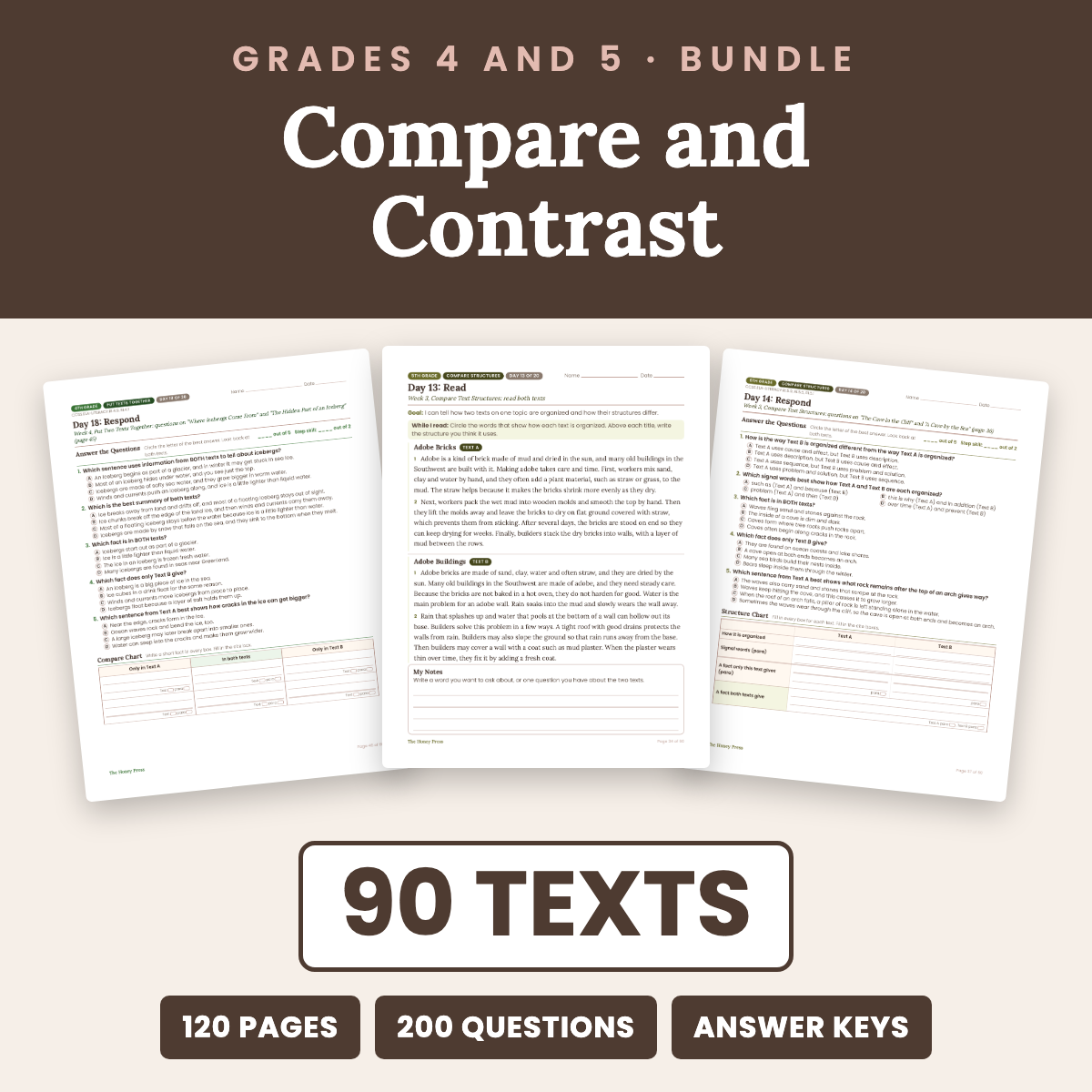
- The Read page stacks Text A above Text B on paired days, each numbered from paragraph 1, with a While I Read task such as "Put a check next to a fact you read in both texts. Put a star next to a fact only Text B tells."
- The Respond page has 5 multiple-choice questions and a Compare Chart with three columns, Only A, Both and Only B (named for the day's subjects when there are two), with a cite box under each fact. In 5th grade Week 3 a Structure Chart takes its place: how each text is organized, its signal words, a fact only it gives and a fact both give. Questions 1 and 2 each day are the week's step skill.
- Day 5 of every week is a Check Day: 5 questions and a short written response in place of the chart, done alone.
- For you: teacher pages with the skill progression, the three standards and how many questions practice each, and a class record for daily scores, Check Day writing and each week's step-skill total out of 10.
- For students: an anchor page with signal words for alike and different, ways a text can be organized, the three-column chart beside a two-circle diagram, sentence starters and how to cite a paragraph, plus a progress tracker.
- Answer keys with the letter, the answer, the text, the paragraph and the exact words for every question, sample answers for every chart and written response, and a 0 to 2 scoring guide for each Check Day.
- Two blank pages for your own texts: a Compare Chart for any two texts, and a Put It Together Planner for a paragraph built from two texts.
The teacher pages set the bar for a week the same way in both grades: Got it means 8 of 10 step-skill questions right and a 2 on the Check Day writing. The student tracker prints the same line.
One question from each grade
Fourth grade, Day 12, two texts on Mars and Venus: "How are Mars and Venus different?" Choices A and B are the same sentence with the planets swapped. The key gives A: Mars has thin air that lets heat escape, but Venus has thick air that traps heat. It quotes Text A, para 2: "Thin air cannot hold much heat" and Text B, para 2: "The thick air traps heat from the Sun".
Fifth grade, Day 12, "A Tower for the Town" and "At the Water Tower": "How is the way Text B is organized different from the way Text A is organized?" The key gives D, problem and solution for Text A and sequence for Text B, and lists the signal words by paragraph: problem and solve in Text A, first, next, later and finally in Text B.
Less help as the week goes on
Day 1 of each week starts the chart with one box filled in from that week's Learn It page. Days 2 to 4 leave every box blank, Check Days have no chart, and Day 20 asks for one paragraph written alone. How long the reading runs:
- 4th grade: about 200 to 214 words for a Week 1 text, about 251 to 288 words for a Text A and Text B pair.
- 5th grade: about 281 to 308 words for each day's pair.
What each grade covers
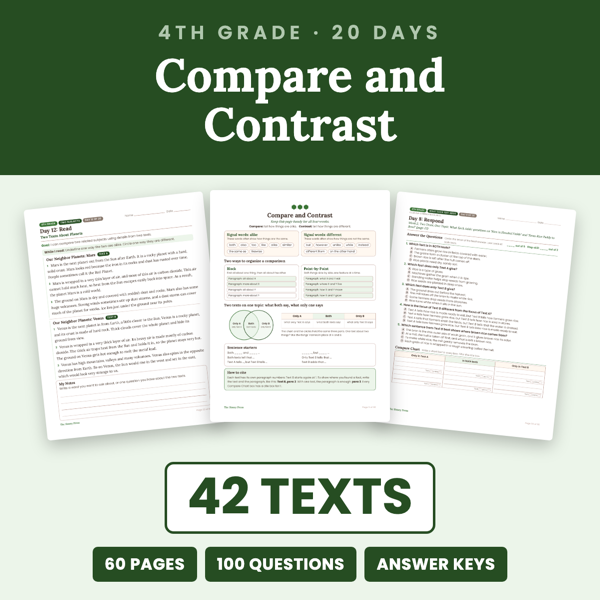
- 4th grade (60 pages, $7.95): One text comparing two things in Week 1, then a Text A and a Text B on one topic: what each adds, two related subjects, and both texts put together.
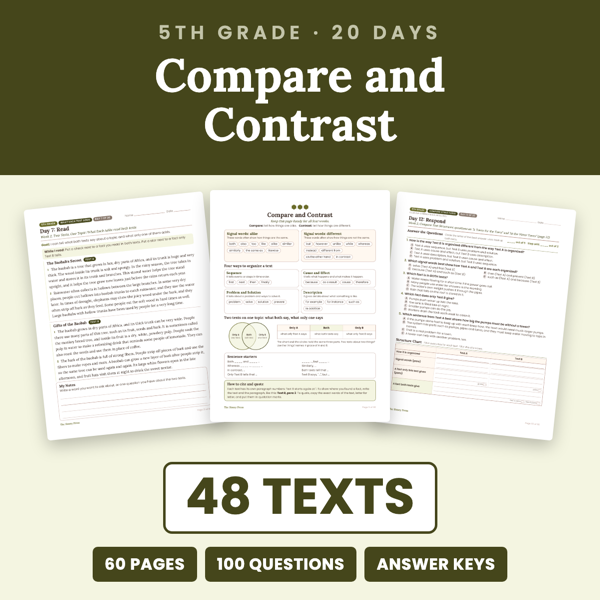
- 5th grade (60 pages, $7.95): Two texts on every one of the 20 days, a week comparing how two texts are organized, and exact quotation questions in Weeks 1 and 4, as RI.5.5 and RI.5.1 ask.
Each packet holds 20 days, 4 Learn It lessons, 100 multiple-choice questions and 4 written responses. Fourth grade has 42 original nonfiction texts (35 on the student days, 7 on the Learn It pages) and 16 Compare Charts. Fifth grade has 48 (40 and 8), 12 Compare Charts and 4 Structure Charts. Fourth grade runs from harbor seals and sea lions on Day 1 to oases on Day 20; fifth grade from skates and stingrays to sand dollars.
The 4th and 5th grade bundle carries both packets, 120 pages, for $11.95, against $15.90 bought separately: 90 nonfiction texts, 40 days, 200 multiple-choice questions, 8 Learn It lessons and 8 written responses. It suits a teacher who loops with a class, or a team that wants one routine for paired texts across both grades.
Where it fits
A day takes 10 to 15 minutes and runs the same way every time, so it fits wherever you have that much time with a class or a group.
The character traits passages run on the same two-page day with short stories, and the main idea passages and synonyms and antonyms passages do the same with single nonfiction passages. So do the idioms passages, with short stories, and the cause and effect passages, with one nonfiction text a day. For a small group that needs six weeks across several comprehension skills, the Tier 2 reading intervention packets are the longer option.
Frequently asked questions
How long does a day take?
Ten to fifteen minutes on two pages. The Read page holds the day's reading and one While I Read task. The Respond page has five multiple-choice questions and a chart, or on a Check Day a short written response.
Is every day two texts?
In 5th grade, yes: all 20 days put a Text A and a Text B on one Read page. In 4th grade, Week 1 reads one text that compares two things, and Weeks 2 to 4 read two texts on one topic. Each text keeps its own paragraph numbers, so a fact can be cited as Text B, para 2.
What changes in 5th grade?
Week 3 compares how two texts are organized. Each pair uses two different structures out of four: sequence, cause and effect, problem and solution, and description, and a Structure Chart replaces the Compare Chart on Days 11 to 14. Weeks 1 and 4 add exact quotation questions, where four versions of one sentence differ by a word or two and only one matches the text, and each Check Day prompt asks students to quote a text.
How do I check the answers?
For every multiple-choice question the answer key gives the letter, the answer, the text, the paragraph and the exact words; a question about both texts quotes each one. Charts and written responses have sample answers, and each Check Day has a 0 to 2 scoring guide.
Which standards does it cover?
Three per grade, with the number of questions on each: RI.4.9 (60), RI.4.5 (10) and RI.4.1 (30) in 4th grade; RI.5.9 (60), RI.5.5 (10) and RI.5.1 (30) in 5th. The teacher pages show where each one is practiced.