Character traits in short stories: twenty days of practice
A short realistic fiction story to read, then 5 questions and a chart, in 10 to 15 minutes a day. Four weeks, one step a week, with a Check Day to close every week: a written response takes the place of the chart. One packet per grade, 4th and 5th grade, or both in one bundle.
Stories by grade
How the twenty days run
Picking a trait word from a list is one job. Finding the trait in a story that never states it, then pointing to the words that show it, is another, and it is the one these packets practice. Students read what a character says, does and thinks, name the trait, and back it up with a clue from the story.
Four weeks, one step each
- Week 1, Actions Show Traits: name a trait from what a character does. Fifth grade also quotes the words that show it.
- Week 2, Traits and Feelings: tell what a character is like most of the time (a trait) from how they feel at one moment (a feeling), using what they say and think.
- Week 3: in 4th grade, Motives: Why Characters Act, explaining why a character does something. In 5th grade, Comparing Characters: a trait two characters share and a trait that sets them apart.
- Week 4: in 4th grade, How Characters Change, from the start of the story to the end and what causes it. In 5th grade, How Characters Interact and Change: how one character's words or actions change another character.
One day, two pages
- A Learn It page opens each week. You read it together: the goal, a three-step strategy, three Words to Know, a model story and a Watch Me think-aloud that answers one question and shows the proof in the story.
- The Read page holds the story, with numbered paragraphs, and one While I Read task. In 4th grade Week 3 it reads: "Put a star next to a sentence that helps you know why a character does something."
- The Respond page has 5 multiple-choice questions and a Character Trait Chart: the character, a trait, the clue from the story, whether the character says, does or thinks it, and the paragraph. In 5th grade Week 3 a Compare Chart takes its place, with a column for each of the two characters.
- Day 5 of every week is a Check Day: 5 questions and a short written response in place of the chart, done without help.
- For you: teacher pages with the skill progression, the two standards and where each is practiced, and a class record with a score column for every day and a writing column for every week.
- For students: an anchor page with trait families set against their opposites (15 in 4th grade, 16 in 5th), trait or feeling, and the three kinds of clues, plus a progress tracker for each day's score and each week's goal.
- Answer keys with the letter, the answer, the paragraph and the words that prove it, sample answers for every chart and written response, and a 0 to 2 scoring guide for the writing.
One question from each grade
Fourth grade, Day 1, "Twenty Pushes Each": "Which word best describes Itzel in paragraph 4?" The choices are fair, unfair, hardworking and careless. The key gives A, fair, with two clues from paragraph 4: "Everyone gets twenty pushes, and then we switch" and "when her own turn came, she hopped off at twenty without being asked".
Fifth grade, Day 16, "The Four Square Rules": "What causes Viggo to change?" The key gives D: Zainab refuses to play by his rules and starts a new game. It quotes paragraph 3: "I won't play if the rules keep changing every turn".
Less help as the week goes on
The first chart of each week prints one example row taken from the Learn It story; in 5th grade Week 3 the example is a finished comparison sentence. The other chart days give only the characters' names, and the Check Day has no chart at all. The stories get longer as the weeks go on:
- 4th grade: about 216 to 228 words in Week 1, 243 to 265 words in Week 4.
- 5th grade: about 224 to 247 words in Week 1, 261 to 299 words in Week 4.
What each grade covers
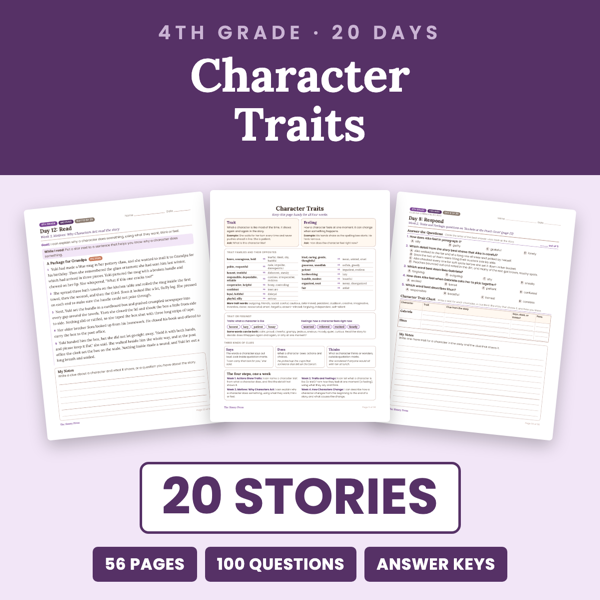
- 4th grade (56 pages, $7.95): Traits from actions, traits set apart from feelings, why characters act, and how a character changes, one step a week, on stories that grow from about 216 to about 265 words.
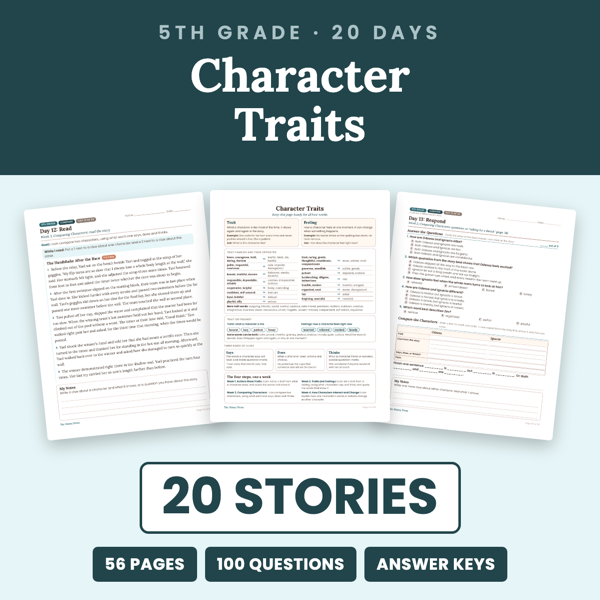
- 5th grade (56 pages, $7.95): The same first two steps, then a week comparing two characters and a week on how one character changes another, with chart clues copied word for word, as RL.5.1 asks.
Each packet holds 20 day stories, 4 Learn It lessons with a model story each, 100 multiple-choice questions and 4 written responses. Fourth grade has 16 Character Trait Charts; fifth grade has 12 Character Trait Charts and 4 Compare Charts. Every story is short, original realistic fiction.
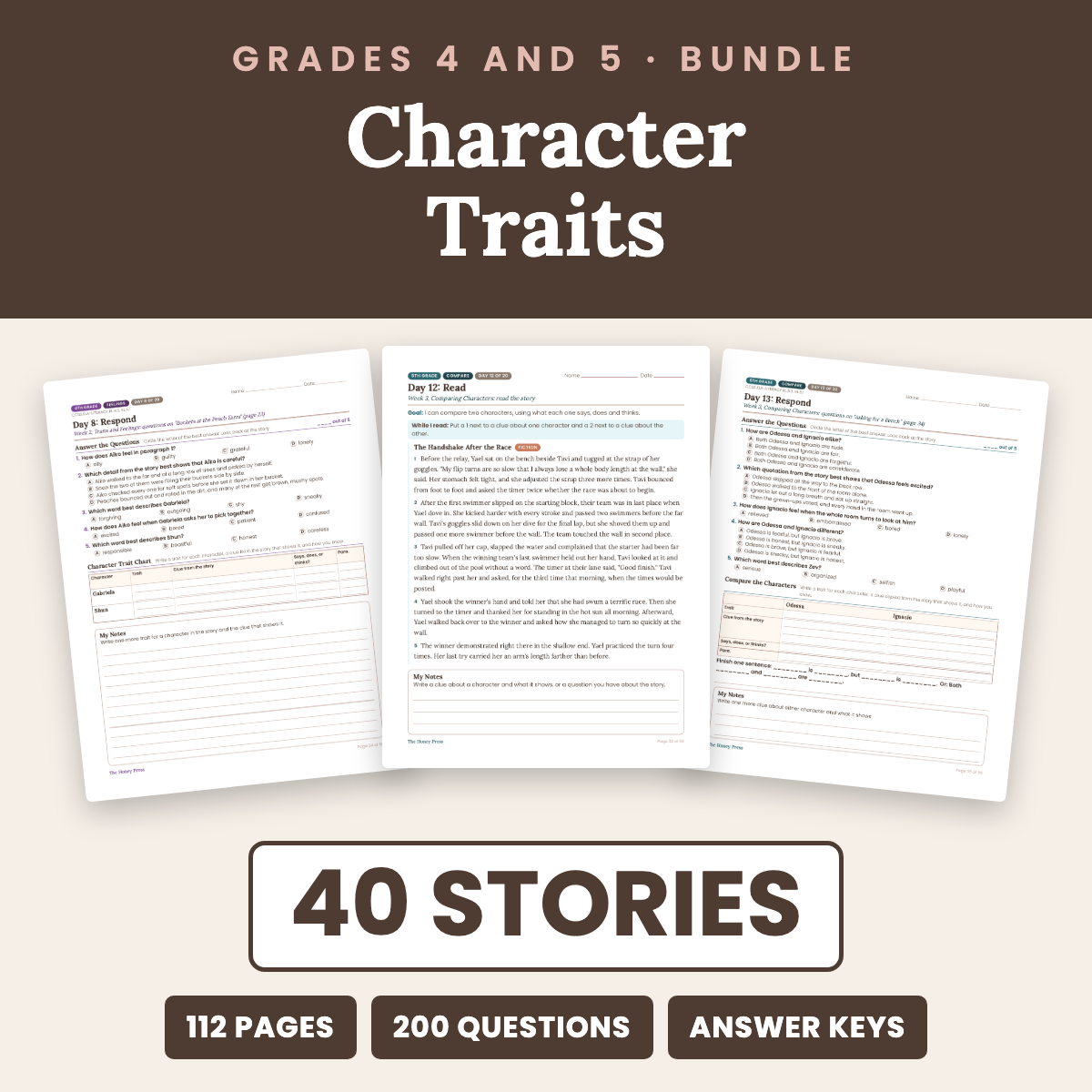
The 4th and 5th grade bundle carries both packets, 112 pages, for $11.95, against $15.90 bought separately: 40 day stories, 200 multiple-choice questions, 8 Learn It lessons and 8 written responses. It suits a teacher who loops with a class, or a team that wants one routine for character work across both grades.
Where it fits
Small groups, centers, morning work, homework or the whole class: a day is short and runs the same way every time.
The compare and contrast paired passages run on the same two-page day with nonfiction, and so do the main idea passages and the synonyms and antonyms passages. The idioms passages run on it with short stories too, and the cause and effect passages with nonfiction. For a small group that needs six weeks across several comprehension skills, the Tier 2 reading intervention packets are the longer option.
Frequently asked questions
How long does a day take?
Ten to fifteen minutes on two pages. The Read page holds the story with numbered paragraphs and one While I Read task. The Respond page has five multiple-choice questions and a chart, or on a Check Day a short written response.
Does a story ever say what the character is like?
No. No story names the trait or feeling its questions ask about. Students work it out from what the characters say, do and think, and the chart asks which of the three each clue is.
What changes in 5th grade?
Weeks 1 and 2 cover the same two steps as 4th grade. Week 3 compares two characters, with a Compare Chart and a sentence to finish: one trait they share, or one that sets them apart. Week 4 asks how one character changes another. Chart clues are copied word for word, and every Check Day prompt asks for quotations from the story.
How do I check the answers?
The answer keys give the letter, the answer, the paragraph and the words from the story for every multiple-choice question. Charts and written responses have sample answers, and each Check Day has a 0 to 2 scoring guide for the writing.
Which standards does it cover?
Two per grade: RL.4.3 and RL.4.1 in 4th grade, RL.5.3 and RL.5.1 in 5th. The teacher pages list each one with where it is practiced, and each Respond page prints only the codes its questions practice.