It is 9 p.m. on a school night. You have known since 3:30 that tomorrow’s math is not planned, and you have spent the hours since then doing everything except planning it, because planning it means opening a browser, and opening a browser means forty tabs, and forty tabs means an hour of comparing things that are all fine, none of which you will feel sure about. So the tab stays closed and the dread stays open.
If that paragraph is your Tuesday, this post is for you. Not the you who needs a better philosophy of teaching. The you who needs tomorrow handled tonight, in about two minutes, without becoming a better person first.
The problem is not the worksheets
Here is the part nobody says plainly: teachers are not short on materials. The internet is a landfill of materials. What you are short on is decisions, or more precisely, the capacity to keep making them at 9 p.m. after a day that already asked you for hundreds.
Teaching is decision-saturated. Which hand to call on, whether that noise needs addressing, how to rephrase the question the third time, whether the lesson is landing or you should bail to the backup. Every one of those spends something, and by evening the account is empty. Then planning shows up and asks for the most expensive kind of decision there is: an open-ended one. Browse anything. Compare everything. No boundary, no finish line, no way to know when you have looked enough.
Open-ended browsing is exactly the kind of task that gets more expensive the more tired the brain doing it is. Some brains pay that tax at a punishing rate every single day. Teachers with ADHD have told versions of this story forever: the work itself is fine, the choosing is the wall. But you do not need a diagnosis of anything to hit that wall. You need a Tuesday in November. The wall is structural, and structural problems do not get fixed by trying harder at 9 p.m. They get fixed by removing the structure that builds them.
So remove the choosing.
The two-minute system
The whole system is three moves, and the first one is the only one that requires thought.
Move one: name tomorrow in one phrase. Not a plan, not a lesson objective. A situation, the way you would say it to the teacher next door. “I might be out sick.” “Homework is chaos.” “I have a new group and no idea where they are.” “Break is coming.” “I just need tomorrow’s math.” Naming the situation takes ten seconds and zero browsing, because you already know which one it is. You have known all evening.
Move two: accept a pre-made answer. This is the move that feels wrong and is not. For any situation you can name in one phrase, a reasonable answer already exists, and the difference between the best answer and a reasonable one is worth far less than the hour of browsing it costs. So you take the one that is handed to you. One packet, chosen in advance by someone who was not tired, with the page count and the price and the print time already stated. You do not compare it to nine alternatives. Comparing is the tax. The system exists to not pay it.
Move three: print, then stop. Not print and then keep looking in case something better exists. Print, close the laptop, done. The stopping is part of the system, not a lack of ambition. A decided Tuesday beats an optimized one you never finish deciding.
That is the entire system. Two minutes is not a marketing number; it is roughly what three moves take when none of them is “browse.”
I built the page version of this for myself
Full honesty: I did not invent this system for you. I invented it because I am the person in the first paragraph. I sell math packets, I know my own shelf better than anyone alive, and there are still nights when my brain flatly refuses to do open-ended anything. On those nights I do not want options. I want someone to just tell me what to print.
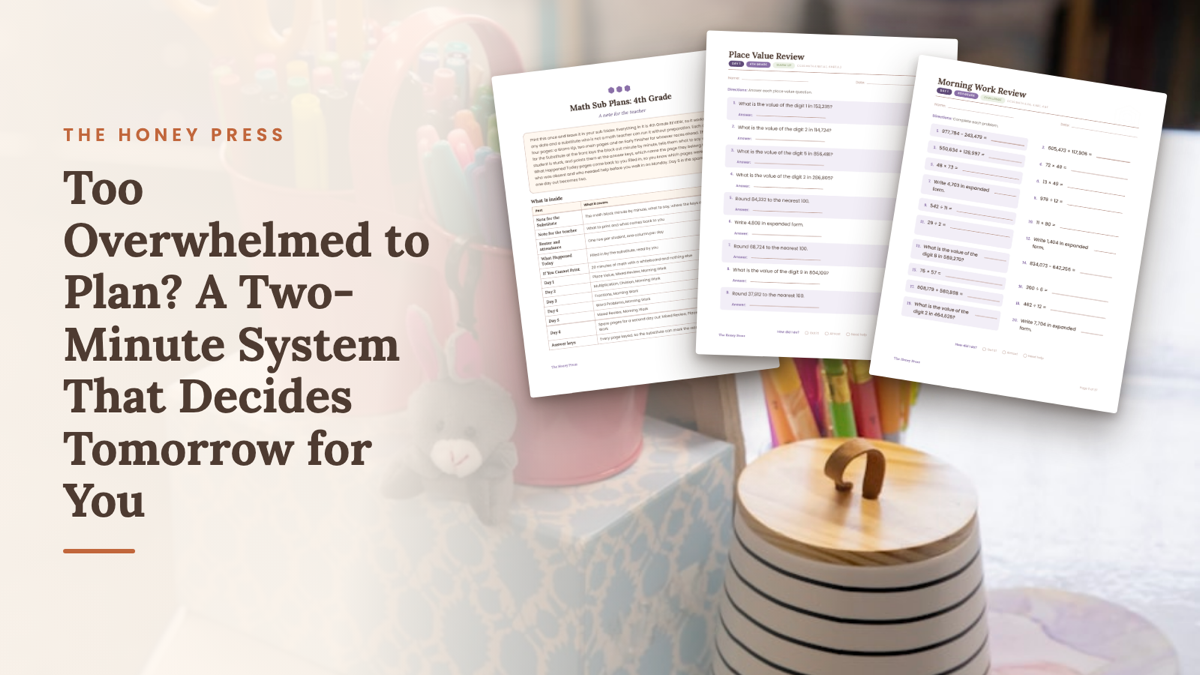
So I built that page, and named it exactly that: Just Tell Me What to Print. It is the two-minute system with the deciding already done. You tap the phrase that describes tomorrow, five of them, big enough to hit on a phone at 9 p.m., and the page hands back exactly one answer: one packet, one real print time, one free sample, one button. No sidebars, no “you may also like,” no second page of results. The design does the simplifying, because on the nights that page is for, you should not have to.
Two design rules on that page matter enough to mention here. First, every number on it is real. The page counts come from the actual listings, and the print times are arithmetic from those counts at ordinary school-printer speed, because an estimate you cannot trust is one more thing to verify, and verifying is deciding in a trench coat. Second, no option gets more than three lines of text. If reading the answer takes longer than accepting it, the page has failed at its one job.
The free-first rule
The system has one more piece, and it is the piece that makes move two safe to trust: you never have to start with money.
Every answer on the page comes with a free sample, and the intended order is always the same. Print the sample tonight, two minutes, no account. Use it tomorrow. Then, and only if the class actually liked it, buy the full packet. If they did not, you spent nothing, and you still got a decided Tuesday out of it, which was the whole point.
I want to be explicit about the permission in that sequence, because overwhelmed people almost never grant it to themselves: you are allowed to stop at the free sample. Forever, if you like. The system is not a funnel with a disguise on. It is a way to make tomorrow stop costing tonight, and a free sample that does that has done the job.
What this does not fix
A pre-decided page does not fix a school that schedules you into the ground, and it does not fix a brain’s relationship with executive function, and it does not claim to. My packets are math, not medicine. What a pre-decided page fixes is one narrow, specific, nightly thing: the gap between “I know tomorrow needs math” and “tomorrow’s math exists on my desk.” That gap is where school nights go to die, and it turns out to be one of the few parts of teaching that someone else can close for you in advance.
So close it the cheap way. Name tomorrow in one phrase. Take the answer you are handed, from my page or from a colleague or from your own emergency drawer, anywhere the deciding was done by somebody who was not exhausted at the time. Print it and stop.
Tomorrow will still ask you for a few hundred decisions. Tonight does not have to be one of them.
